
In the Canadian Consumer Price Index (CPI), housing costs are captured under the shelter component, the single largest category in the basket, representing more than 29 per cent of the total weight as of the 2025 update. The shelter index is divided into two major subcomponents: rented accommodation and owned accommodation, each capturing distinct household housing expenses.
Rented accommodation represents a significant share of the shelter index and includes monthly rent paid by tenants, along with related expenses. As of the 2025 basket update, rent accounts for 7.19 per cent of total CPI weight, an increase from previous years due to increasing rental costs nationwide.
Mortgage interest cost captures only the interest portion of monthly mortgage payments. Because it reflects actual payments rather than newly offered mortgage rates, it adjusts gradually and changes only when mortgages renew or refinance.
CPI rent inflation is calculated using rents paid by a representative sample of tenants, including those on existing leases. This results in slower adjustments compared to market rent indicators, which reflect newly listed units.
Canada’s Consumer Price Index (CPI) rose 2.3 per cent year-over-year in January 2026, continuing the cooling trend observed throughout late 2025 as sharply lower gasoline prices exerted downward pressure on the headline rate.
The shelter index increased 1.7 per cent year-over-year—the first time in nearly five years that shelter inflation has fallen below 2 per cent. Rent rose 4.3 per cent year-over-year, outpacing headline CPI, while mortgage interest costs increased 1.2 per cent.
CPI Shelter Trends Chart (Apr 2025 – Jan 2026)
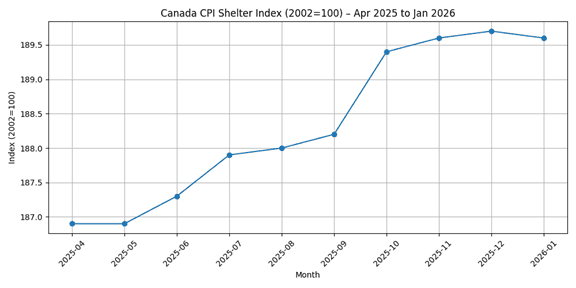
Source: Statistics Canada
Given the current level of mortgage rates and market rents, shelter costs are likely to have a moderating influence on CPI in the months ahead, providing a solid anchor for inflation over the coming year.
Housing Affordability Watch
CMI monitors the latest developments and offers insights on solutions to Canada’s housing affordability crisis
Edmonton and Calgary are outbuilding almost every city in Canada, yet both are now caught in a political standoff that could put hundreds of millions in federal funding at risk. Our latest Housing Affordability Watch looks at how the Housing Accelerator Fund’s one‑size‑fits‑all design is generating friction in two of Alberta’s major growth centres.
Read the full analysis here: One Size Doesn’t Fit All: How the Housing Accelerator Fund Is Creating Conflict in Alberta

Independent Opinion
The views and opinions expressed in this publication are solely and independently those of the author and do not necessarily reflect the views and opinions of any person or organization in any way affiliated with the author including, without limitation, any current or past employers of the author. While reasonable effort was taken to ensure the information and analysis in this publication is accurate, it has been prepared solely for general informational purposes. Any opinions, projections, or forward-looking statements expressed herein are solely those of the author. There are no warranties or representations being provided with respect to the accuracy and completeness of the content in this publication. Nothing in this publication should be construed as providing professional advice including investment advice on the matters discussed. The author does not assume any liability arising from any form of reliance on this publication. Readers are cautioned to always seek independent professional advice from a qualified professional before making any investment decisions.
